

How Many Tools Does Your Business Use? The Case for Bringing It All Together
CRM, Business Productivity, Tool Consolidation
Too Many Business Tools? Why a Unified CRM Platform Just Makes Sense
Quick question: how many different tools does your business currently use? Email here. CRM there. Social media somewhere else. It works—until it doesn’t. When every task lives in a separate tab, your team spends more time juggling systems than serving customers. That’s exactly the problem unified platforms like CRM Connect are built to solve.
The Hidden Cost of Tool Sprawl
On paper, using “best of breed” tools for every function sounds smart. In reality, tool sprawl quietly eats into your time, budget, and data quality.
- Lost time: Sales checks leads in the CRM, jumps to email for follow-ups, opens another app to schedule meetings, then copies notes into a spreadsheet. Those tiny switches add up to hours of context switching every week—and slower response times for customers.
- Data silos: Marketing tracks campaigns in one tool, support logs tickets in another, finance invoices from a third. No one sees the full customer story, so reports are incomplete, decisions are based on guesses, and teams argue over whose numbers are “right.”
- Subscription fatigue: Each new tool brings another monthly fee, another renewal date, and another training curve. It’s easy to end up paying for overlapping features you hardly use—while still feeling like you’re missing something.
What an All‑in‑One CRM Platform Really Consolidates
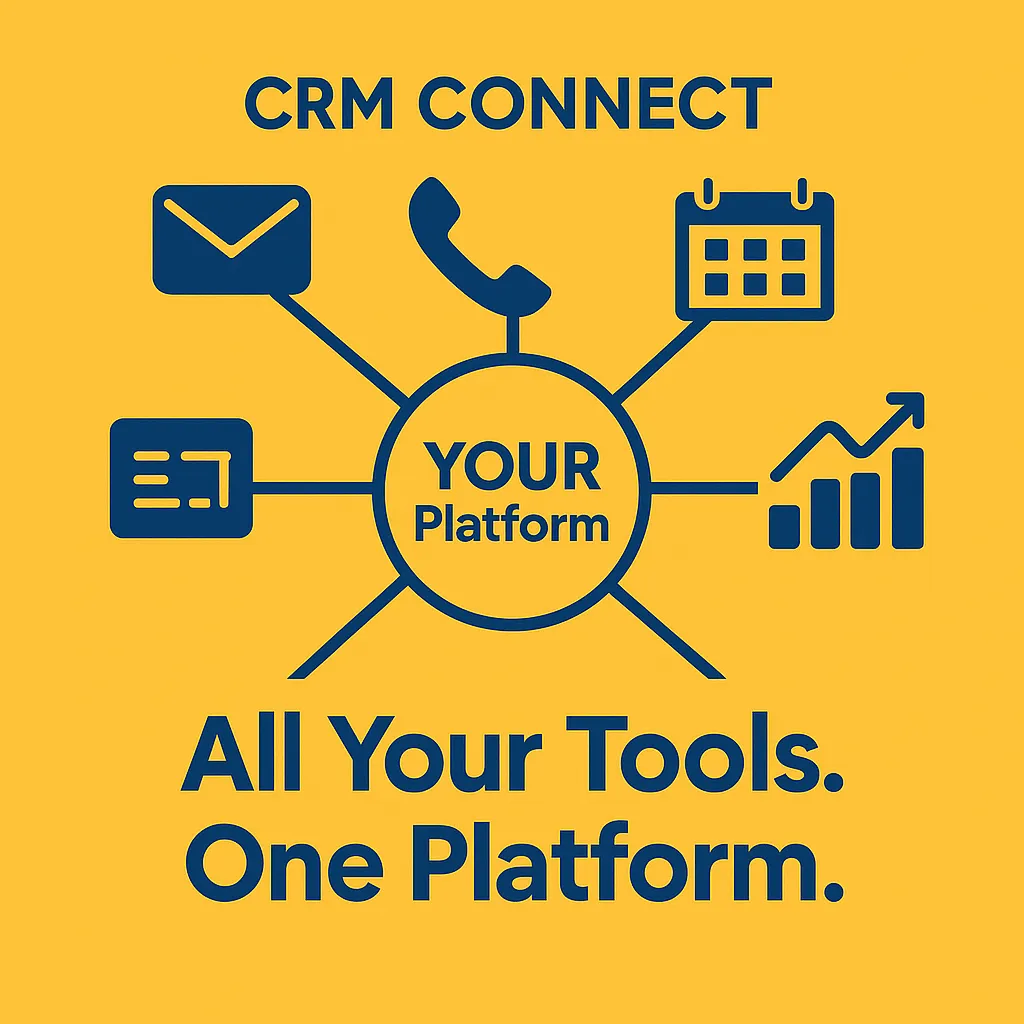
A modern all‑in‑one CRM platform like CRM Connect pulls your scattered tools into one connected workspace. Instead of stitching together half a dozen apps, you get a single hub that typically includes:
- Contact and deal management: Centralized records for leads, customers, and accounts, plus pipelines and stages everyone can see.
- Email and communication: Built‑in email, templates, sequences, and often phone, SMS, and live chat, all tied to each contact’s history.
- Marketing tools: Forms, landing pages, basic marketing automation, and social media scheduling that feed data straight into the CRM.
- Support and tasks: Ticketing, shared inboxes, tasks, and reminders so follow‑ups never slip through the cracks.
- Reporting and dashboards: Real‑time views of revenue, pipeline health, campaign performance, and service metrics—using one consistent dataset.
How Unifying Tools Boosts Productivity and Data Quality
When everything lives in one place, your team simply moves faster. Reps can send emails, log calls, update deals, and book meetings without leaving the CRM. Marketers can see which campaigns actually turned into revenue, not just clicks. Support can view a customer’s full journey before replying to a ticket.
Just as important, your data gets cleaner. Instead of duplicate contacts scattered across tools, you maintain a single source of truth. That means more accurate reports, better segmentation, smarter automation, and less manual cleanup. Over time, this clarity translates into more confident decisions and more consistent customer experiences.
Is Consolidation Right for Your Business?
Consolidating into an all‑in‑one CRM is a strategic move, not just a software swap. To decide if it’s right for you, start with a quick self‑check:
- Count your tools: If core workflows rely on five or more disconnected apps, there’s likely room to simplify.
- Ask about reporting: Can you easily answer “What’s working?” across sales, marketing, and support? If not, data silos are in your way.
- Review your invoices: Add up monthly software spend, including “small” tools. Compare that to the cost of a unified platform with overlapping features.
- Gauge your team’s frustration: If people complain about double entry, lost context, or too many logins, consolidation could bring immediate relief.
If these points sound familiar, exploring an all‑in‑one solution like CRM Connect is worth your time. By bringing your tools—and your teams—together, you trade scattered effort for focused growth, and turn your CRM into the calm, connected center of your business.